

You drive on low tyre pressure through sand, mud or rocky terrain for maximum grip. The tyre's footprint increases, the vehicle travels more smoothly over the terrain. Until the tyre comes off the rim. Without beadlock, low tyre pressure is a risk that quickly ends in a tyre sliding off the rim.
A beadlock rim solves this problem by mechanically clamping the inside of the tyre to the rim. It is one of the most functional upgrades for a serious off-road setup, but also one of the most misunderstood. In this article, we explain what a beadlock does, when you need it, the difference between types and what to look out for when choosing one.
What is a beadlock and how does it work?
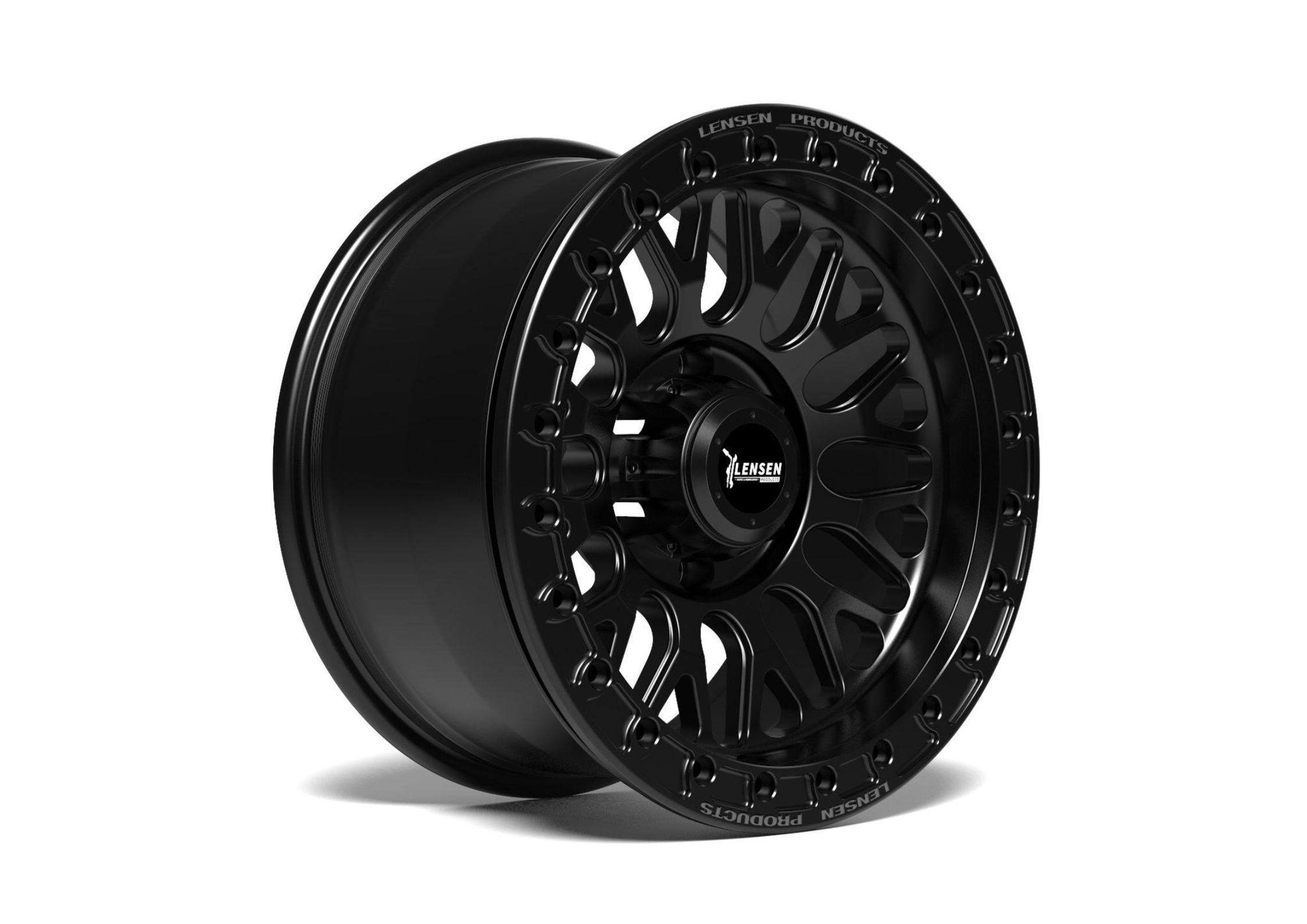
A beadlock is a rim with a special outer ring that is mechanically secured with bolts around the rim flange. The inner whelst of the tyre, the bead, is clamped between the rim flange and the beadlock ring. This prevents the tyre from sliding off the rim, even when the tyre pressure is close to zero.
A standard rim holds the tyre in place solely by the tyre pressure. Once the pressure is greatly reduced, the tyre loses its lateral rigidity and the whelst can fold inwards. With a beadlock rim, the whelst is mechanically locked regardless of the tyre pressure. This makes it safe and controllable to ride with very low tyre pressure.
The beadlock ring is secured with a series of bolts, typically 16 to 32 depending on the rim size. It is important to check and tighten these bolts regularly, as vibrations on rough terrain can gradually loosen the bolts.
At Lensen Products, our own CNC Forged Beadlocks are available in multiple sizes and designs. View our range of Lensen beadlock rims for the available options.
Why drive with low tyre pressure?
The reason for reducing tyre pressure off-road is immediate: lower pressure increases the tyre's footprint. A larger footprint means more contact with the surface, more grip and better distribution of vehicle weight over a larger area.
On a standard rim, it is safe to ride with a tyre pressure of around 1.2 to 1.5 bar in light off-road use. As soon as you want to go to 0.8 bar or lower for heavier terrain, the risk of tyre shearing increases sharply. With a beadlock rim, riding at 0.4 to 0.6 bar is safely controllable.
CNC Forged beadlocks: what makes the difference?
Cast vs. forged aluminium
Not all beadlock rims are the same. There are cast aluminium beadlocks, steel beadlocks and CNC-milled or forged aluminium. Lensen Products CNC Forged Beadlocks are manufactured from forged aluminium that is then CNC-milled to the final tolerances. Forged aluminium has a denser crystal structure than cast aluminium, resulting in higher tensile strength and better resistance to cracking under impact and lateral loading.
For serious off-road use, where the rims are regularly exposed to high impact and bending forces, this is a substantial difference. A cast rim can crack or tear under heavy impacts, while a forged variant absorbs the same impact without permanent deformation.
Accuracy and clamping pressure
A CNC-machined rim offers more precise dimensioning of the beadlock ring and bolt holes. This ensures uniform clamping pressure across the entire circumference of the tyre, with no high-pressure spots or weak points in clamping. Uneven clamping pressure due to sloppily fabricated bolt holes eventually leads to tyre casing wear and reduced reliability of the lock.
Tailor-made configuration
The Lensen CNC Forged Beadlocks are fully configurable: you choose your own model, size, colour, ring, hub cap and bolts. This allows you to match the rims to the aesthetics of your build, from subtle black versions to striking colour accents on the beadlock ring.
See all options on the Lensen Beadlocks product page.
Available sizes
The Lensen Beadlocks are available in 15, 16 and 17 inches. These are the most common rim sizes for off-road use and offer a wide choice of compatible tyre sizes. When choosing, always pay attention to the hub pitch (PCD) and hub opening, which should exactly match your vehicle's hub specifications.
Beadlocks and the law: what is allowed in the Netherlands?
In the Netherlands, beadlock rims are not permitted for use on public roads in most cases, unless they have a TUV inspection or other approved certification. For competition use, use on private land or for vehicles used exclusively off-road, this is not an obstacle. If you want beadlocks on a vehicle that is also used on the road, check the homologation requirements with the RDW or a recognised inspection body.
When do beadlocks make sense for your setup?
Beadlocks are the right choice as soon as you want to ride off-road structurally with a tyre pressure below 1 bar. This is the case for expedition and overland driving on sand dunes or desert terrain, for competitive off-road driving on rocky terrain such as trial and rock crawling, when using large muddertires on heavy mud trails and for vehicles used for beach driving.
For recreational off-road riding on mixed terrain with tyre pressures of 1.2 bar or higher, beadlocks are less necessary. They may provide an extra margin of safety, but the functional need is less immediate.
Want to further complete your off-road setup? Then also read our blog on the coilover upgrade for your suspension and the air locker for maximum traction.
View the Lensen CNC Forged Beadlocks
Lensen Products CNC Forged Beadlocks are designed for riders who don't want to compromise on quality and customisation. Fully configurable in model, size, colour and finish and manufactured from forged aluminium for maximum strength. View all configuration options on the product page or view the full Lensen Beadlocks range.
Do you have questions about the right size, hub pitch or configuration for your vehicle? Contact us for personal advice. We are happy to help you make the right choice.