

Putting together a recovery kit for your 4×4: what do you really need?
Anyone who drives off-road will, sooner or later, reach a point where traction isn’t enough. Mud, sand, snow, deep ruts or a poorly chosen line can cause your 4×4 to get stuck. You don’t want to be left scrambling for recovery equipment at that point. A good recovery kit is ready and waiting before you need it.
But what should a kit like this actually contain? You can make your recovery kit as comprehensive as you like, but the basics must be right: strong enough, suitable for your vehicle and safe to use. In this blog, we’ll list the most important components.
Start at your vehicle and use
Not every recovery kit needs to be the same. A light off-road vehicle requires different equipment to a heavily kitted-out 4×4 with a winch bumper, roof tent, extra fuel and luggage. The terrain also makes a difference. In sand and mud, you often use different techniques to those used on rocky terrain or in deep ruts.
So, first take a look at:
- the weight of your vehicle;
- the type of terrain you usually ride on;
- whether you’re setting off on your own or with several vehicles;
- whether you have fitted a winch;
- how much space you have to work safely.
A recovery kit shouldn’t just be powerful. It also needs to be practical to use. Items that are tucked away at the very back of the car or don’t fit in with your setup are of little use when you’re stuck.
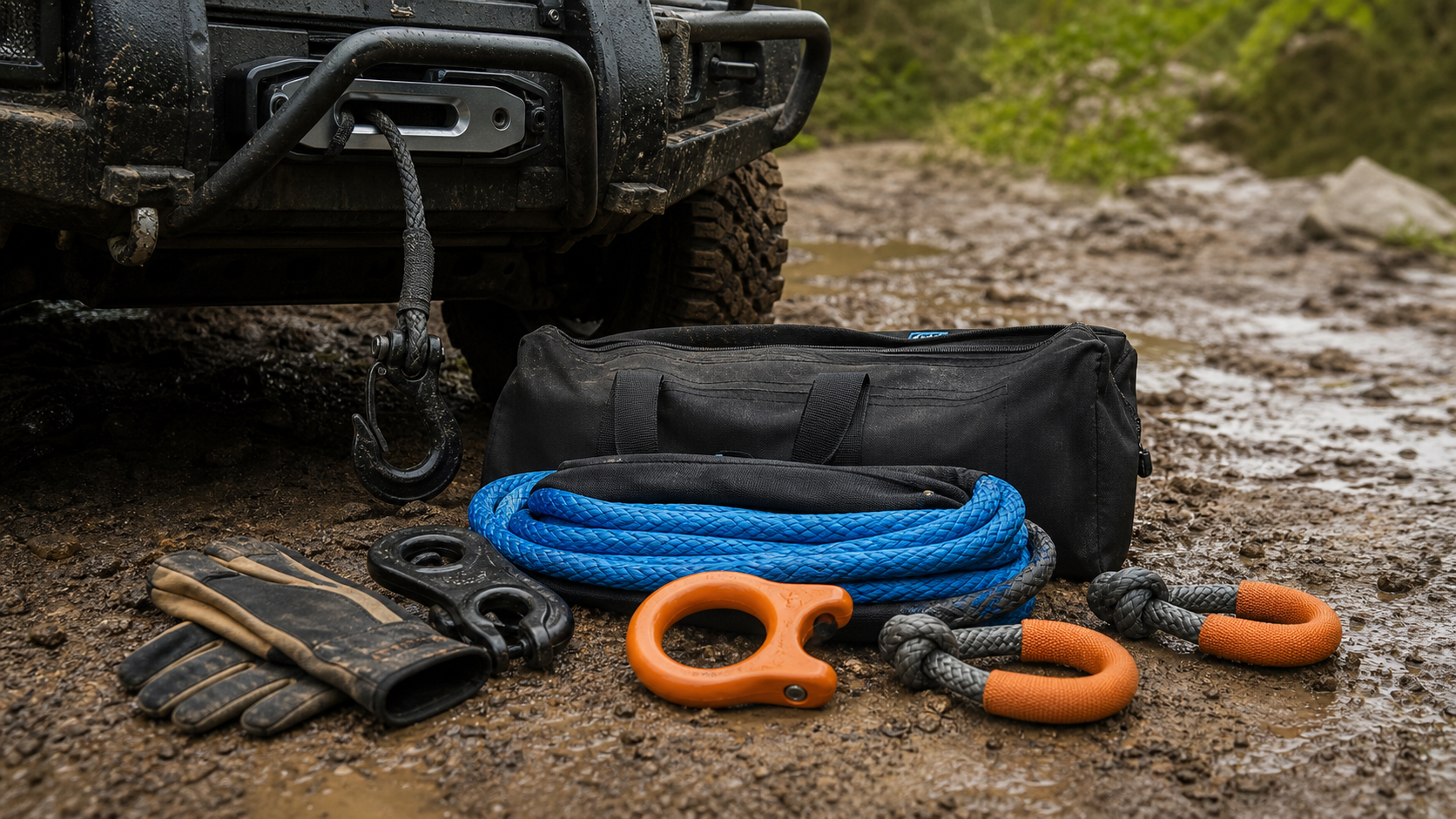
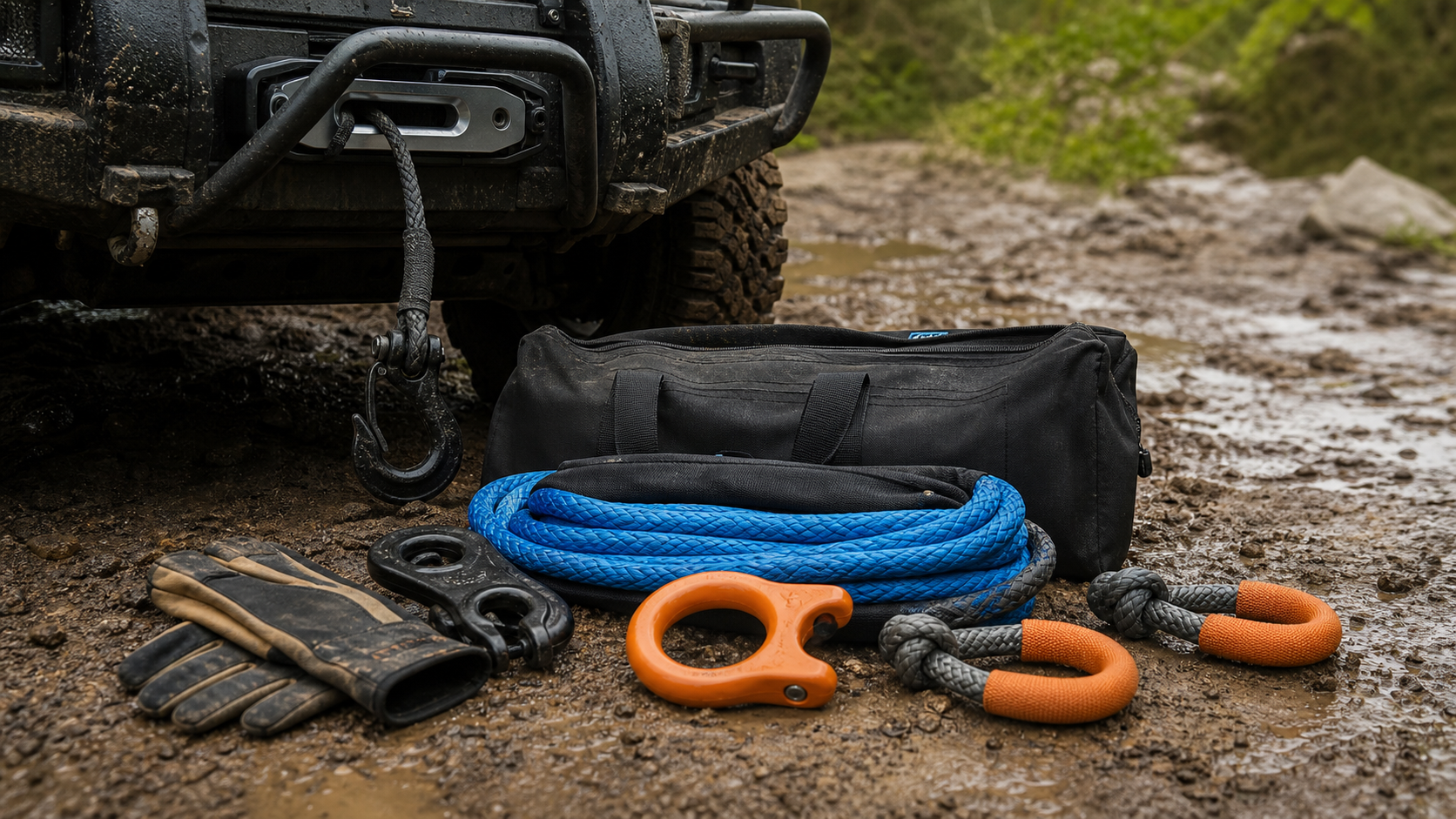
Kinetic rope: smooth deployment
A kinetic rope is one of the most useful pieces of equipment for two-car vehicle recovery. The rope stretches as the vehicle is pulled free. As a result, the pulling force builds up more gradually than with a rigid tow strap or chain. This often makes the pulling process smoother and easier to control.
At Lensen Products, you’ll find kinetic ropes in various diameters and lengths, such as 19 mm, 22 mm, 25 mm and 26 mm. The right choice depends on the vehicle’s weight and the recovery situation. A heavier car requires a stronger rope with a higher breaking strength.
When using a kinetic rope, pay particular attention to:
- diameter and tensile strength;
- length, for example 6 or 9 metres;
- condition of the rope;
- protection against sharp edges;
- secure attachment points on both vehicles.
Only use a kinetic rope with suitable recovery points. A standard towing eye or weak attachment point can become dangerous under high loads.
Soft shackles: a lightweight yet strong connection
Soft shackles are popular in modern recovery kits. They are lightweight, take up little space and are easier to handle than heavy metal fastenings. A soft shackle is designed to connect recovery components to one another, for example, a kinetic rope to a recovery point or a snatch ring to your winch line.
The main advantage is that a soft shackle is lighter. If something goes wrong, you want as little heavy metal under tension as possible. That doesn’t mean you should be careless with it: always check for wear, cuts and dirt.
A practical set usually contains at least two soft shackles. This gives you flexibility when you need to attach to different points or when using a snatch ring.
Snatch ring or snatch block: working smarter with your winch
When using a winch, a snatch ring or snatch block can make a big difference. You can use them to adjust the direction of pull or set up a double line. This helps distribute the load more evenly and allows the winch to operate more smoothly.
A snatch ring is often used in combination with synthetic winch rope and soft shackles. It is compact, lightweight and has few moving parts. This makes it a good choice for many modern 4×4 set-ups.
Always use a snatch ring with components that are compatible with one another. The load on the winch, the winch rope, the shackle, the recovery point and the ring must all be correct as a whole. Ultimately, the weakest link determines what is safe.
Harness accessories: don’t forget the small parts
If you have an electric winch, your recovery kit isn’t just the winch itself. It’s the accessories that determine how easily and safely you can work in practice.
Things to bear in mind:
- a fairlead to ensure smooth running of synthetic rope;
- a wireless or wired winch control;
- a suitable winch rope;
- gloves;
- a snatch ring or snatch block;
- strong recovery points;
- a damping device or safe working procedure for live lines.
Good rope guidance is particularly important with synthetic winch ropes. Sharp edges, awkward angles or dirt can shorten the rope’s service life.
Recovery points: only strong material counts
A recovery kit is only safe if you can attach it to suitable points. Not every tow eye on a car is suitable for pulling a vehicle free under heavy loads. Some tow eyes are designed for transport or light towing, not for dynamic recovery.
You should therefore use robust recovery points, tow eyes or winch trays that are suitable for your vehicle and intended use. If in doubt, it is advisable to have the mounting assessed or fitted by a professional. Off-road recovery places a great deal of stress on components that are not always designed to withstand it as standard.
What’s the minimum you need to take with you?
For a practical basic set, you could consider:
- 1 kinetic rope suitable for your vehicle’s weight;
- 2 soft shackles;
- 1 snatch ring or snatch block if you’re using a winch;
- gloves;
- suitable recovery points on the car;
- a bag or box to keep everything clean and within easy reach.
If you have fitted a winch, expand the set with a suitable winch rope, a remote control, a fairlead and, if required, additional winch accessories.
Check your kit after use
Recovery equipment is put through its paces. Mud, sand, moisture and heavy loads can cause wear and tear. Rinse the ropes clean, leave them to dry thoroughly and check the soft shackles and winch rope for damage. Only store everything away once it is clean and dry enough.
Can you see any fraying, cuts, sharp kinks or other suspicious damage? If so, don’t just reuse the part. When it comes to recovery, you want to be able to rely on your equipment.
Conclusion: put together your recovery kit carefully
A good recovery kit doesn’t have to be complicated, but it does need to be suited to your vehicle and your driving style. With a strong kinetic rope, soft shackles, good recovery points and suitable winch accessories, you’ll be well on your way.
If you often drive on rough terrain or set off on your own, it’s worth putting together a more comprehensive and robust kit. Take a look at Lensen Products’ recovery range and choose parts that suit your 4×4, the terrain and how you use it.